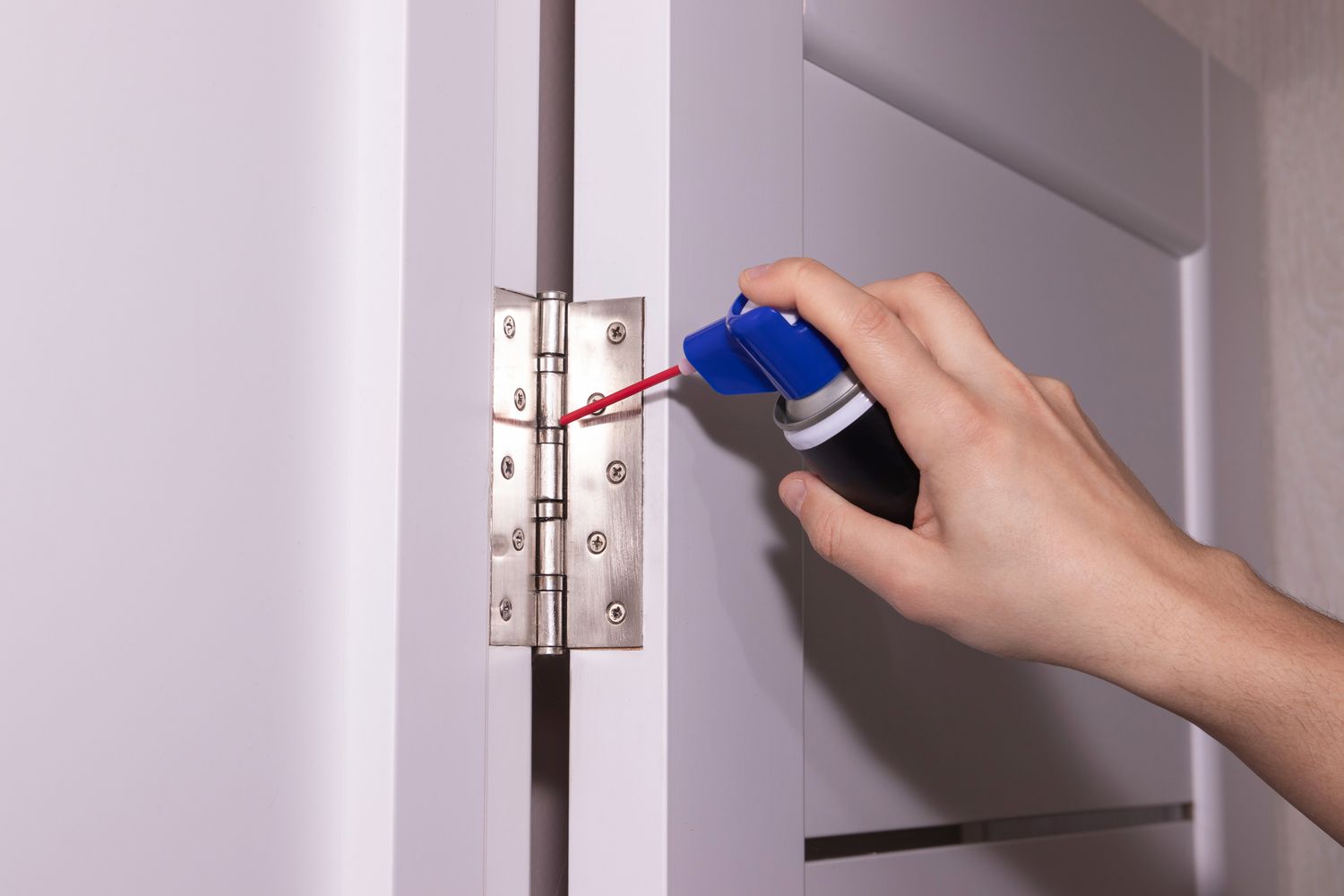
There are few household problems that haven’t, at some point, been attacked with a can of WD-40.
Squeaky hinge? Spray it.
Stiff lock? Spray it.
Patio door suddenly takes both hands to open? Give the track a generous coating and hope for the best.
Sometimes the door even feels better afterwards, which rather encourages the habit.
The problem is that stiffness isn’t always a lubrication problem. On sliding doors, bifolds and multipoint UPVC systems, resistance can be the first sign of worn rollers, dropped alignment or a mechanism being forced to work under loads it was never designed to handle.
That is why someone carrying out UPVC mechanism repairs will usually want to know why a component has become stiff rather than simply making it move more freely.
The spray can has its uses.
Diagnosis isn’t one of them.
The classic stiff-handle problem
This is probably the best example.
A UPVC door handle becomes increasingly difficult to lift. Nothing appears broken and the door still locks, provided you pull it firmly into the frame first.
The obvious assumption is that the lock needs lubricating.
Sometimes it does.
Quite often, the locking mechanism is stiff because the door has dropped slightly and the locking points no longer line up correctly with their keeps in the frame.
The mechanism is effectively being asked to drag the door into position every time somebody lifts the handle.
Spray lubricant into it and the internal components may move a little more easily.
But the door is still out of alignment.
So the homeowner carries on.
Lift harder. Pull the door towards you. Give the handle that little extra shove at the top.
It becomes routine.
Eventually something inside the gearbox gives up.
At that point everyone says the lock has broken, which is technically true. It just wasn’t necessarily the original fault.
Doors train their owners remarkably well
This is one of the stranger things about household repairs.
People adapt.
If a door changes slowly enough, the person using it every day often develops a little technique without consciously thinking about it.
Lift it slightly.
Pull it towards you.
Push near the bottom.
Turn the key while holding the handle halfway up.
Visitors can’t operate the door, but the homeowner can.
That’s usually a warning sign in itself.
A properly adjusted external door shouldn’t require insider knowledge.
The same happens with sliding patio doors. They become gradually heavier over several years, so the owner simply pulls harder. Because the deterioration is incremental, there isn’t one obvious day when the door went from good to bad.
Then somebody else tries to open it and says, “Why is this so heavy?”
Only then does it become apparent.
Sliding doors suffer from a different version of the problem
With sliding patio doors, the spray tends to go directly into the bottom track.
It makes intuitive sense.
Door doesn’t slide properly. Lubricate the surface it slides on.
Except the visible track isn’t necessarily where the fault lies.
Most sliding systems rely on rollers underneath the door. Those rollers carry a considerable amount of weight and, after years of use, they can wear, flatten, corrode or become damaged.
Sometimes they seize.
A damaged roller dragged repeatedly along a track can then start damaging the track itself.
Adding lubricant may temporarily reduce some of the noise and friction, but it hasn’t turned a damaged roller back into a round one.
This is where delaying patio door repairs can become unnecessarily expensive.
The initial problem might be the running gear.
Keep forcing the door and eventually the running surface can suffer too.
Then there is the locking system at the other end, which is also being operated while the door is sitting at the wrong height.
One problem starts introducing itself to several others.
Dirty tracks and lubricant make an unpleasant combination
Garden doors get filthy.
There’s no elegant way of putting it.
The track across a rear opening sits in exactly the right place to collect everything a garden can throw at it. Soil, grit, tiny stones, dried leaves, moss, dog hair, crumbs, dust and whatever the children have walked through five minutes earlier.
Much of it is abrasive.
Spraying lubricant over that contamination can bind everything together into a sticky paste.
The door then runs across it repeatedly.
Again and again.
On a frequently used summer door, that could happen dozens of times a day.
It is a bit like lubricating a bicycle chain without ever cleaning the grit off it. Yes, there is lubrication present. There is also a lot of abrasive material being carried directly through moving components.
Cleaning matters.
Sometimes more than lubrication.
Not every lubricant belongs in every lock either
There is another misconception here.
If a product lubricates something, it must be suitable for every moving component.
Locks and door mechanisms don’t all want the same treatment.
Some products attract dirt. Some leave residues. Some can interfere with particular materials or finishes. Cylinder manufacturers may recommend specific types of lubricant rather than whatever happens to be sitting in the garage.
This doesn’t mean homeowners need to become amateur mechanical engineers before touching a door.
It just means indiscriminate spraying isn’t maintenance.
There is a difference.
A squeaking hinge with no other symptoms is one thing.
A multipoint locking mechanism that has become dramatically harder to operate over six months is another.
The latter deserves a little more curiosity.
Bifolds make random adjustments even riskier
Bifold doors add several more opportunities for enthusiastic DIY intervention.
The temptation is understandable because adjustment points are often visible. A homeowner sees a panel rubbing against another, finds an online video showing somebody turning a screw and thinks: that’s easy enough.
It might be.
But bifold panels operate as a connected system.
Change the position of one and you can affect the gaps elsewhere. Lift one corner and another locking point may move. Correct a rub at the bottom without understanding why it appeared and the lead door might become harder to close.
Then the lubricant comes out because the lock has mysteriously become stiff.
There is usually a sequence behind these problems.
The useful question isn’t just “what is rubbing?”
It’s “why did it start rubbing?”
Wear?
Settlement?
A loose adjustment?
A damaged roller?
Debris?
Thermal expansion?
Poor installation from the beginning?
Those possibilities require different fixes.
A lot of repairs begin with something tiny
One small stone can be enough.
That sounds ridiculous given the size and cost of some modern glazed door systems, but running gear works to relatively fine tolerances.
A piece of gravel trapped in the wrong place can obstruct movement or damage a roller.
Homeowners often respond by pushing harder.
Crunch.
The obstruction either moves or gets crushed.
Door opens.
Problem apparently solved.
Except now there may be a damaged component underneath a panel weighing far more than anybody wants to lift manually.
This is particularly common during summer because bifolds and sliders spend far more time open. Garden debris gets inside and doors are used repeatedly throughout the day.
The busiest doors are often the least maintained ones.
The extension boom made all this more noticeable
Large glazed openings have become normal.
A generation ago, the average rear entrance might have been a single door or modest pair of French doors. Now plenty of extensions have three, four, five or six moving panels spanning most of the rear elevation.
That changes the mechanical equation.
More weight.
More rollers.
More hinges.
More locking points.
Longer tracks.
More opportunities for dirt and alignment problems.
It also means a door fault can have a much bigger effect on how a house is used.
If the main opening between a kitchen extension and garden becomes difficult to operate, families notice quickly.
Especially during warmer months.
The result is often a frantic attempt to make it usable immediately.
Clean the track quickly.
Spray something into it.
Force the stiff panel.
Deal with it properly another day.
Another day can become another year surprisingly easily.
“It worked afterwards” doesn’t necessarily mean it worked
This is perhaps why temporary fixes are so persistent.
They often appear successful.
Spray a stiff mechanism and it becomes easier.
Adjust a hinge and the rubbing stops.
Clean one visible part of the track and the door moves better.
Job done.
Except sometimes the improvement merely masks the symptom.
If the door is misaligned, lubrication can reduce the resistance enough to make the problem tolerable without correcting the alignment.
The underlying load remains.
That matters because internal components are still working harder than intended.
Eventually the temporary improvement disappears.
Usually the next attempt involves more lubricant.
Then more force.
By the time someone inspects the door properly, the original problem can be difficult to separate from the damage caused afterwards.
Locks often get blamed unfairly
There are plenty of genuinely failed locks, of course.
Mechanical components wear out.
But door alignment has a huge influence on how long multipoint mechanisms survive.
A useful basic observation is how the handle behaves when the door is open compared with when it is closed.
If a mechanism operates smoothly with the door open but becomes extremely stiff once the door meets the frame, that tells you something.
The mechanism clearly can move.
Its relationship with the frame is where the difficulty appears.
That doesn’t diagnose the exact problem, and homeowners shouldn’t start dismantling locking systems based on it, but it does illustrate why replacing parts blindly can be wasteful.
Sometimes the lock isn’t asking for lubricant.
It’s asking the rest of the door to line up with it.
Forcing the handle can get expensive surprisingly quickly
Door handles create leverage.
That’s useful when everything is functioning properly.
Less useful when a locking system is jammed against misaligned keeps.
The harder somebody pushes, the more force travels into the mechanism.
Eventually the weakest internal component loses the argument.
This can turn a door that was awkward but usable into one that won’t lock at all.
Then the repair becomes urgent.
This pattern is particularly common when a household has tolerated the problem for months. Everyone knows the handle is stiff. Everyone has learned the special technique.
Then a guest uses it.
Or a child hangs on the handle.
Or somebody is in a rush and forces it slightly harder than usual.
That’s it.
The mechanism fails.
The final action gets blamed, but the problem was already waiting.
Weather can make a marginal door suddenly feel broken
Yorkshire weather adds another complication.
A door can behave differently between a warm August afternoon and a cold wet November morning.
Materials expand and contract. Seals behave differently. Moisture gets into dirty tracks. Buildings move fractionally through seasonal cycles.
A door that is already marginally misaligned may therefore feel perfectly acceptable one month and awful the next.
That doesn’t mean a squirt of lubricant every season is the answer.
Repeated seasonal stiffness is useful information.
If the same door becomes difficult whenever temperatures rise or fall sharply, there may be an alignment tolerance issue worth investigating.
Bifold doors are particularly good at revealing this because multiple panels need to maintain their relationship with each other across a relatively wide opening.
There are perfectly sensible things homeowners can do
Not every stiff door requires an urgent callout.
Basic housekeeping prevents plenty of problems.
Tracks can be kept clear of stones, soil and other debris. Drainage areas shouldn’t be allowed to disappear beneath years of dirt. Visible screws and components can be checked for obvious looseness without randomly changing their adjustment.
Most importantly, changes in how the door operates shouldn’t be ignored indefinitely.
There is a big difference between maintaining something and trying to repair a fault without knowing what caused it.
Cleaning a dirty track is maintenance.
Turning every adjustment point until a bifold stops rubbing is experimentation.
Those are not the same activity.
The best repair is often the one done before failure
People understandably wait because a stiff door doesn’t feel urgent.
It still opens.
It still closes.
It still locks if you know how.
That last sentence should probably bother us more than it does.
Once a door requires force or a particular technique, something has changed mechanically. Catching it at that stage can mean an adjustment, a worn component or a relatively contained repair.
Waiting until the mechanism physically breaks removes some of those options.
And that is the limitation of the trusty spray can.
It is very good at making certain moving parts move more freely.
It cannot straighten a dropped door.
It cannot make a worn roller round again.
It cannot move a locking keep back into alignment.
And, despite several decades of determined British household experimentation, it still can’t fix everything.